Niagara Falls Turned Off – Why Did It Happen?
Last updated on June 4, 2026 by W R
Have you ever thought about emptying a giant tank full of water? How would you think it would look? How would you feel about it? That is exactly what we are going to reveal to you today. It is all about amptying a magnificent world wonder in a single day and its impact on engineers and onlookers. Niagara Falls turned off: why did it happen? Read on to learn the reason and history behind this occurrence.
Introduction: Niagara Falls Turned Off
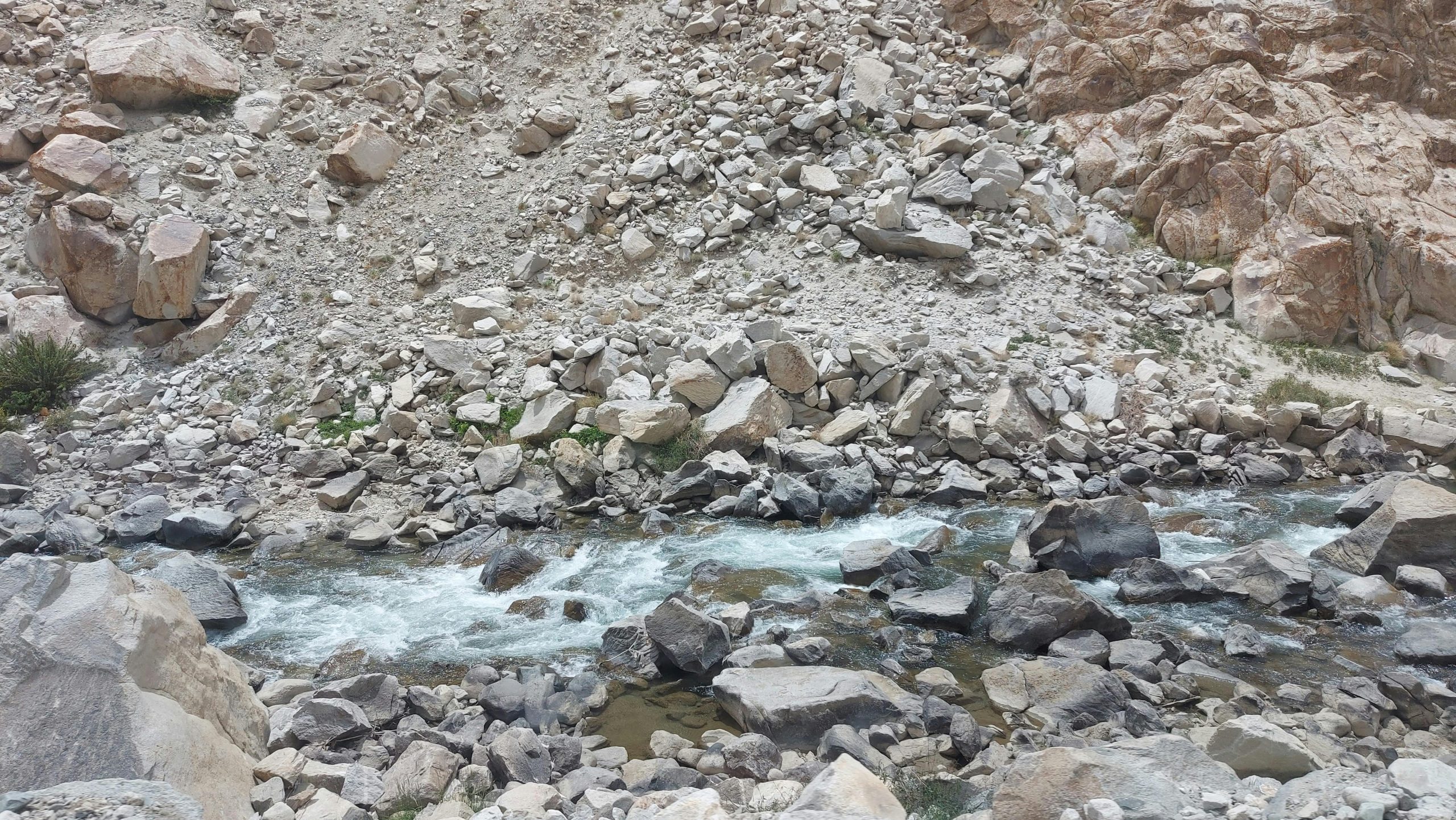
In the summer of 1969, the United States Army Corps did something out of the ordinary. That is to turn off one of the most powerful and magnificent waterfalls in the world. Yes, that is right! They turned off the mighty and thundering Niagara Falls from the American side. The falls, which usually carry millions of gallons of water, were reduced to a dry, rocky cliff. This is something that has not happened in thousands of years in Niagara Falls’ history.
Niagara Falls Turned Off: Why Did They Do It?
Now the question you might ask is, “Why did they turn off Niagara Falls in the first place?” Well, the answer might surprise you. They turned off the falls purely for aesthetic reasons, to give them a facelift. Tourists would flock to see how the falls look without water, which was something that they wouldn’t witness on a typical tour on any other day. With no water at all, onlookers saw thousands of coins in the empty rocks. So, they came and collected these in buckets. Something not so amazing was the sight of human remains included among these artifacts.
How was it possible to empty Niagara Falls? What did scientists discover when the falls were empty, and what did they learn from it?
History: Niagara Falls Turned Off
Niagara Falls Turned Off
Early History
The earliest history of Niagara Falls goes back 12,000 years. It is when the ice age was closing in, and the colossal Laurentide ice sheet began moving northward. This left a carved basin, which is how the Great Lake came to be, and how the Niagara River formed, channeling excess water from Lake Erie towards Ontario.
However, this is not the Niagara Falls we see today. In fact, it lay further downstream and was broader and more magnificent than the falls we see today.
Introduction To Tourism
The falls slowly migrated upstream due to erosion and the formation of limestone. This occurrence caused the falls to retreat approximately 7 mi to their current position. The indigenous people considered the falls to be sacred, while European travelers were far from this notion. Their documentation states the waterfall is massive and they considered it to be a magnificent landscape in the entire world. So, Niagara Falls became one of North America’s popular tourist destinations and scenic viewpoints for a fee, especially for honeymooners and families.
Notable characters from that era came to view the wonder of Niagara Falls. With the introduction of railroads, it started to expand beyond the region, where people from areas like Buffalo and Albany also came to experience this beauty. It became easily accessible for people from all over, especially within hours. People began to do extreme things like stunts and going over the falls in a barrel, all of which proved to be somewhat dangerous.
Experience the beauty of Niagara Falls today. Book your tour now!
Key Highlights: Niagara Falls Turned Off
From Gallons Of Water To A Trickle
In March 1848, people noticed something wrong with the falls. The thundering sound of the falls was fading, and by March 30th, it stopped entirely. The cause was a huge ice jam at the eastern end of Lake Erie. It was blocking water from falling into the river, thereby cutting the water supply to Niagara Falls. This was a natural occurrence due to the late winter weather and didn’t have anything to do with human engineering principles. People thought of it as a divine intervention. Nearby mill owners were concerned about how to get power to their machinery.
People discovered many things in the area that had not seen dry air for thousands of years. From weapons to archaeological relics and human remains, there were many things buried underneath the falls.
Back to Basics
The ice jam broke off approximately 30 to 40 hours after its formation. The falls were back to their thunderous form, mesmerizing onlookers as usual. However, it did help people realize that they could stop the water flow of the falls. This would eventually lead to the notion of the falls being stopped in the coming years. Gradually, the falls became a source of unfathomable energy.
Niagara Falls: A Source of Energy
In the 1890s, Nikola Tesla and George Westinghouse developed the first large-scale AC power station in the Niagara Falls region. This project, which was completed in 1895, demonstrated for the first time that AC power could be transmitted over long distances. The Edward Dean Adams power plant transmitted electricity to the city of Buffalo, which was a significant moment in the history of electricity. Now, the falls were not merely a tourist attraction but also an engineering marvel.
The Challenge
However, the catch was that the engineers had to divert the water flow from the falls using turbines. This impacted the actual water flow of the falls, and onlookers and tourists realized this in no time. So, the goal was to use the water to generate electricity while also not impacting the tourism industry.
Agreement Between The Two Countries
The United States and Canada jointly agreed to set limits on how much water needed to be diverted to generate power. They planned to preserve the scenic flow during daylight hours when tourists mostly visited the falls. Up to 75% of the river’s water is diverted at night for hydroelectric generation. This was the perfect balance, with North America benefiting from the water to generate power and businesses flourishing due to the growth in the tourism industry.
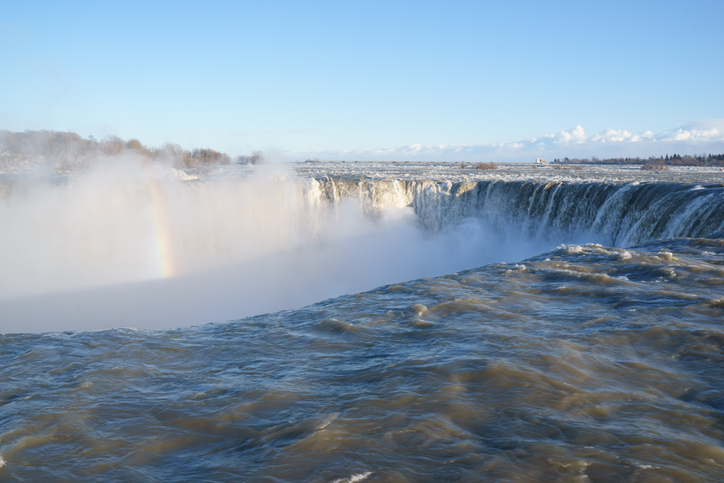
Niagara Falls – Back to Gushing Water
Analysis & Decision: Niagara Falls Turned Off
Erosion
When everything seemed to be perfect, the American Falls began to crumble by the mid-twentieth century. It was facing the risk of erosion, which directly impacted the visual side of Niagara Falls due to the collapse of the rock face at the base of the American Falls. Large boulders had accumulated at the base due to rock falls as the American Falls lands on a slope of broken rock. The falls were losing their beauty and were looking less like a waterfall day by day and more like a trickle of water dripping over rocks.
Analysis & Decision
The two countries got together to study this problem and decided to reshape the falls to look more dramatic. This means the engineers would have to cut off the water supply to the falls. In the spring of 1969, the US Army Corps of Engineers started to build a temporary rock and earth coffer dam across the Niagara River. It was 2000 feet long and needed approximately 30,000 tons of rock to build. The diversion was completed on June 12, 1969. Thousands of people came to see the American Falls, which was turned off by that time.
Engineers examined the rock face in detail and identified that it was getting more fractured and weakened over time. They had to decide whether the waterfall needed to be cleared to restore its visual appeal. However, environmentalists argued that manipulating this natural wonder could cause more harm than good. Finally, they decided to leave the falls as they were, as removing the rock piles would be very expensive
Conclusion
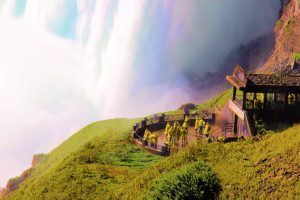
The American Falls has its own beauty even without manipulation via human intervention. Its boardwalk provided amazing views of the falls to visitors, which is not something you would experience on the Canadian side. Today, the falls stand in beauty as a testament of time.
Explore more by booking your Niagara Falls tour today!